Showing posts with label pitching a novel. Show all posts

Thursday, April 20, 2017

Page to Screen - Pitching Tips for Book to Movie

Are you an author? A screenwriter? Have you ever pitched your work to a producer or a studio in hopes of seeing your book on the big screen?

Now you can.
In Spokane, Washington. The link to Connecting Writers with Hollywood is at the end of this blog, if you think you have something that would adapt well.

I've written blogs and magazine articles on my experiences pitching to producers, studio heads, screenwriters etc but today I want to offer something more hands-on, practical, to anyone who is headed somewhere with the intention of pitching their book to anyone who might adapt it to a big screen (or a little screen!)

First, remember that you have a product to sell and you're not taking up someone's time if their job is to acquire material (product) for their company. You don't need to feel beholden to the person you pitch to. They are looking for people like you and should be eager to listen to your pitch.


Do your homework. Prepare until you are sick of the sound of your own self-promoty voice.
Here are some questions that will help you prepare your pitch so that you come off as the confident sales person you are.

Book or Screenplay?:
Title:
Genre: (High Action War Movie. Romantic Comedy, Dystopian Young Adult etc)
Logline: (One sentence crux of your story- see below blog)
Short Pitch (in about 200 impact-filled words - Each section must drive the action and build the suspense of what’s coming next. The conclusion should be tight and must tie up all loose ends.)
Why will your project make an AMAZING movie?
-Location/Setting (See your setting through a movie camera lens)
-Story line (Touch on Goal, Motivation, Conflict)
-Action (make a list of all the action scenes in your story)
-Characters (Make them come to life in description)
What is the Essence of your story? (Describe the soul of the book in one sentence)
What actors could play the leads (Use well-known, current, successful, popular in that genre stereotypes, not your favorite, little-known actor who usually doesn't play this type of role)
Film or TV Series (Imagine how your project would look as a Feature Film, an Indie Film, or on an HBO limited series, or a sit-com on Network TV)
LOGLINES: Very important! Take time to write a great one. 
WHO?
GOAL?
OBSTACLE?
If it doesn't take you at least an hour to write the perfect logline for the movie of the adaptation, go back to fine-tune it. A meandering log line or pitch suggests a poorly written story.
Here are example log lines from movies:
A Pennsylvania steel-town ambitious and hot headed high school coach tries to spoil a football hero’s scholarship dream. 
A thief, who steals corporate secrets through use of dream-sharing technology, is given the inverse task of planting an idea into the mind of a CEO.
A team of explorers travel through a wormhole in space in an attempt to ensure humanity's survival.  
An insomniac office worker, looking for a way to change his life, crosses paths with a devil-may-care soap maker, forming an underground fight club that evolves into something much, much more. 
A seventeen-year-old aristocrat falls in love with a kind but poor artist aboard the luxurious, ill-fated R.M.S. Titanic.
 A writer and wall street trader, Nick, finds himself drawn to the past and lifestyle of his millionaire neighbor, Jay Gatsby.
   __________________________________________________________________________
Now go write a log line.
Just before you pitch, gather all the enthusiasm you can muster (think of the time someone asked you if you love your newborn baby) and pitch like this is the best idea EVER and the person in front of you will benefit greatly from your genius. Pretend you are telling a campfire story, not rattling off sentences.
You only get one chance to pitch and then it's GONE!
Join us in Spokane!
Connecting Writers with Hollywood - Spokane Washington, May 25 - 27th
www.cwwh2016.com
(Don't be fooled by 2016 - This is the site for the 2017 Conference where I'll be teaching on the Thursday afternoon - just before Chuck Palahniuk, who wrote The Fight Club!)

Kim Hornsby is the Author of Award-Winning The Dream Jumper's Promise available on Amazon Books. She is a Bestselling Supernatural Suspense Author who lives in the Seattle area where she writes during the rainy months.

Tuesday, April 5, 2016

I (Shamelessly) Pitched my Novel to Hollywood!

I pitched my novel, The Dream Jumper's Promise, to Hollywood players last weekend. That's the short version.
Former Cover

Here's the long version:
Over two days at the Universal City Hilton Hotel, I got 7 minutes of unadulterated privacy with a Hollywood producer to share the bare bones of my story line.
Final Cover
I also shoved my book into the purses of two other producers, one of whom said she thought my log line was intriguing, the other who was basically trying to leave the room. I weaseled my way into conversations and made the most of my short stint in Hollywood like my children's futures depended on this weekend, which is kind of true. As a polite Canadian, I'm not proud of my behavior but I had a brief opportunity to make a connection and I tried to put myself out there, just in case.


How Did I Happen Upon This Opportunity?
Just before I left the room to pitch!

The organization, Sisters in Crime, has a Hollywood chapter that's run by screenwriters, scriptwriters, actors, novelists, talented people in their own right, and they organized an event for an elite number of novelists to come together at the Hollywood Hilton last weekend to learn how to adapt a book to Hollywood and pitch said book to some high powered producers. Free! A friend referred me.
I was accepted very last minute and booked a plane ticket that cost way more than if I'd planned this in advance. But, this was the opportunity of a lifetime for me. I'm a big movie fan, former actress, and pitching to Hollywood just sounded so damn sexy when I said it out loud!


What Did it Involve?
Over 48 hours, we authors were treated to talks from David Isaacs (Writer of Mad Men, Cheers, Frasier, Mash etc), Ron Mardigian (former senior agent at William Morris), Pam Veasey (producer/writer CSI Cyber), and a host of other industry professionals that would knock your socks off. Can you say Giving Back? Pretty sure these people didn't get paid and most of them did not come to the Hilton necessarily looking for a book to adapt.
Some did though.
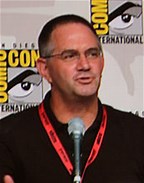
Hart Hanson, creator of Bones
Over the two day event we networked, schmoozed, learned how to write a treatment, pitched, and watched a scriptwriter fall off a stage and break his ankle. True. I was talking to another polite Canadian who writes Bones when the writer of Agents of Shield stepped back and disappeared off the back of the stage where he'd just charmed everyone with stories of writing for Hollywood. Both Hart Hanson and I said "Excuse me," like polite Canadians, and bolted to the scene.

When the guffuffle died down, I spoke briefly to the producer who'd caught my attention during the talk and sounded like she might be open to a new idea, Michele Mulroney (Sherlock II) and she took my novel. I have to admit, I felt a bit whorish doing business right after Drew's accident but hey, it's Hollywood and I'd scraped together the pennies to get to California. I had one shot at Michele Mulroney and Hart Hanson was off to the ER with Drew. I'd been about to hand Hart my novel and beg him to develop a TV show around The Dream Jumper when our attention landed elsewhere. Damn.

The day before, I'd pitched to Jane Goldenring who took my book, applauded my one liner, was very gracious and accomplished, and I'm hoping she takes a look at my little Indie self-pub and sees something that would translate to the big screen and make a lot of money.
I also pitched to Stan Spry from Cartel Management and he liked the idea of the book and referred me to Haley Stoessl, Manager of Development. Haley gave me her card.

Drew Greenberg at hotel valet stand after the Emergency Room. 
Friday night, at the Sisters in Crime cocktail party, I descended on Snowfall Films exec and powerhouse, Suzanne Lyons, who asked me to send her something-- Suzanne is also Canadian and happens to be funny as hell. Marianne Moloney, who was once a VP at Universal, and discovered the book Ordinary People also worked on Roxanne, one of my favorite movies, with Steve Martin. She said I had a great name, for whatever that's worth. I hope to find her contact info and will remind her of my great name.
We met readers for studios like Dreamworks and Amblin, who spend all day reading books to recommend, or not, to their bosses. They talked about what they look for. One turned down Fifty Shades of Grey and stands by that decision.
The whole weekend was absolutely fascinating and I got on the plane Saturday night with a thirty-seven pound head full of info and full of myself because hey, I frickin pitched to Hollywood!

Here's my log line:
The Dream Jumper's Promise is about a guy who can slip into other people's dreams and uses that to solve a crime.

Here's some of what I learned this weekend in a nutshell (a pistachio, not a walnut):

-Hollywood likes books better than concepts because novels are finished, complete, characters are fleshed out. Authors are pre-approved.
-Sometimes not having a huge contract with a big 5 agency will be appealing because the rights to your book are more readily available and cheaper.
-Be prepared for changes to your book. The screenwriter might completely change everything but make sure you get credit: Based on the Novel The Dream Jumper's Promise
-Managers can work harder for a client than an agent if you're with a BIG agency
-Unsolicited material isn't as welcome as if your agent sends it (or your entertainment attorney!)
-Learn how to write a treatment, do not leave out the ending in all its beauty
-Scouts in New York meet regularly with agents trying to find books that will adapt to movie well
-Ask your agent to get on the Friday list to producers--Notable Books of the Week
-Get an agent! Imperative to lend credibility to your project.
-Find the one thing unique to your book and lead with that in your pitch
-Don't try to tackle screenwriting to sell your novel, There are experts for this.
-If a producer options your book (ties it up while trying to get a studio on board) be patient
-When you pitch, tell it like a campfire story with lots of vocal inflections.
-No more than 5 characters in pitch
-Only pitch action, no dialogue
-Thrillers are popular, especially with a female protag
-In the pitch, include the hard decisions that turn the plot
-To get these people's attention, you need something unique and you need to be aggressive. Not obnoxious, Ron said, but aggressive.
-Short Stories sometimes rise to the top of the pile for TV ideas
-If a producer options your book it may take a year or two to get the studio, director, screenwriter on board. You must be patient.

Good Luck. Somebody's going to get a movie made from their book.
It might as well be us, right!?


Kim Hornsby is an Amazon Bestselling Author who's shared the top five list with J.D. Robb, Stephen King and Dean Koontz in Amazon's Suspense Lists. She's an Award-Winning Mystery/Thriller writer who combines Danger, Adventure and often Ghosts.
Find Kim's many books on her author site at Amazon,